A forex (or foreign exchange) scam is any trading scheme used to defraud individual traders by convincing them that they can expect to gain a high profit by trading in the foreign exchange market. Currency trading "has become the fraud du jour" as of early 2008, according to Michael Dunn of the U.S. Commodity Futures Trading Commission. But "the market has long been plagued by swindlers preying on the gullible," according to the New York Times . "The average individual foreign-exchange-trading victim loses about $15,000, according to CFTC records" according to The Wall Street Journal. The North American Securities Administrators Association says that "off-exchange forex trading by retail investors is at best extremely risky, and at worst, outright fraud."
“In a typical case, investors may be promised tens of thousands of dollars in profits in just a few weeks or months, with an initial investment of only $5,000. Often, the investor’s money is never actually placed in the market through a legitimate dealer, but simply diverted – stolen – for the personal benefit of the con artists.”
In August, 2008 the CFTC set up a special task force to deal with growing foreign exchange fraud.”
The forex market is a zero-sum game[7] , meaning that whatever one trader gains, another loses, except that brokerage commissions and other transaction costs are subtracted from the results of all traders, technically making forex a "negative-sum" game.
These scams might include churning of customer accounts for the purpose of generating commissions, selling software that is supposed to guide the customer to large profits, improperly managed "managed accounts", false advertising, Ponzi schemes and outright fraud. It also refers to any retail forex broker who indicates that trading foreign exchange is a low risk, high profit investment.
The U.S. Commodity Futures Trading Commission (CFTC), which loosely regulates the foreign exchange market in the United States, has noted an increase in the amount of unscrupulous activity in the non-bank foreign exchange industry.
An official of the National Futures Association was quoted as saying, "Retail forex trading has increased dramatically over the past few years. Unfortunately, the amount of forex fraud has also increased dramatically..." Between 2001 and 2006 the U.S. Commodity Futures Trading Commission has prosecuted more than 80 cases involving the defrauding of more than 23,000 customers who lost $350 million. From 2001 to 2007, about 26,000 people lost $460 million in forex frauds. CNN quoted Godfried De Vidts, President of the Financial Markets Association, a European body, as saying, "Banks have a duty to protect their customers and they should make sure customers understand what they are doing. Now if people go online, on non-bank portals, how is this control being done?"
- The nominal exchange rate e is the price in foreign currency of one unit of a domestic currency.
- The real exchange rate (RER) is defined as
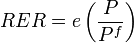 , where Pf is the foreign price level and P the domestic price level. P and Pf must have the same arbitrary value in some chosen base year. Hence in the base year, RER = e.
The RER is only a theoretical ideal. In practice, there are many foreign currencies and price level values to take into consideration. Correspondingly, the model calculations become increasingly more complex. Furthermore, the model is based on purchasing power parity (PPP), which implies a constant RER. The empirical determination of a constant RER value could never be realised, due to limitations on data collection. PPP would imply that the RER is the rate at which an organization can trade goods and services of one economy (e.g. country) for those of another. For example, if the price of a good increases 10% in the UK, and the Japanese currency simultaneously appreciates 10% against the UK currency, then the price of the good remains constant for someone in Japan. The people in the UK, however, would still have to deal with the 10% increase in domestic prices. It is also worth mentioning that government-enacted tariffs can affect the actual rate of exchange, helping to reduce price pressures. PPP appears to hold only in the long term (3–5 years) when prices eventually correct towards parity.
More recent approaches in modelling the RER employ a set of macroeconomic variables, such as relative productivity and the real interest rate differential.
